A society of animals: What ‘Zootopia’ reveals about us

by Ian Gallmore and Elena Nicholson

A society of animals: What ‘Zootopia’ reveals about us article image

Hover over red text to see commentary.

Imagine a perfect city: free public transportation, clean streets and lush green spaces everywhere you turn. The people living in the city are pleasant, always greeting you and welcoming you into their world. They each have their niches, sure, but are also unafraid to venture out and explore other neighborhoods. Plus, the infrastructure is accessible for all kinds of bodies — making travel throughout each borough seamless. A true utopia for all. Oh yeah, and everyone is a non-human mammal.
Comments from Elena
Non-human mammal is a term that takes human superiority out of the equation. It puts humans back on the animal level and helps us examine our role as part of an ecosystem, instead of framing the “human” as separate from the “animal.” This phrasing connects the human to the animal. Describing a human as an animal is generally an unsavory comment, often rooted in racism or prejudice. But in reality, we are all animals.
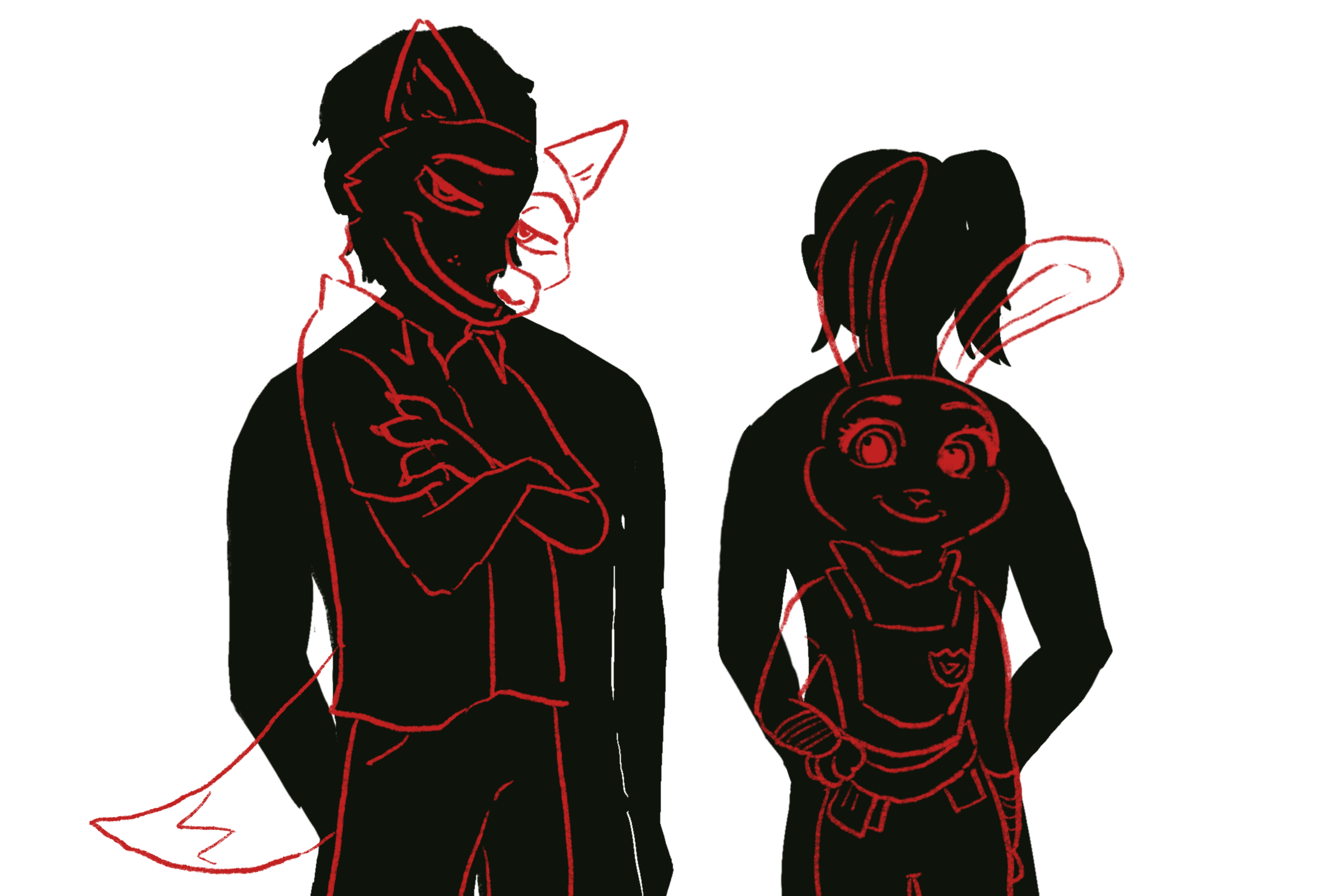
Welcome, my dear zoophilist, to Zootopia. Zootopia exists as a product of the (ironically) very human desire to envisage utopia; it’s no surprise that it’s derived from a portmanteau of “zoo” and “utopia” (although the European name opts for a combination with “metropolis” instead). Yet despite this uncanny description, the two films featuring the city showcase the cracks in this proposed ontology. In each, Nick Wilde (Jason Bateman), the aptly named fox protagonist, teams up with Judy Hopps (Ginnifer Goodwin), the even more aptly named bunny protagonist. Throughout their time as partners (and I mean that word in
Comments from Elena
One of the main theories surrounding the Zootopia franchise is whether the leads — Nick and Judy — are romantic partners or just work partners. If they were to have a romantic relationship, this would cross another boundary within the framework of the movie. Species are separated based on their ability to reproduce. Though it is a fictional movie, it is interesting that this is a real-life boundary the directors may not be willing to cross.
all its connotations)
Comments from Elena
One of the main theories surrounding the Zootopia franchise is whether the leads — Nick and Judy — are romantic partners or just work partners. If they were to have a romantic relationship, this would cross another boundary within the framework of the movie. Species are separated based on their ability to reproduce. Though it is a fictional movie, it is interesting that this is a real-life boundary the directors may not be willing to cross.
), the two tackle some of the ugliest underlying parts of the “perfect” animal society: a corruption scandal traced all the way to the mayor’s office paired with underground drug trafficking and species redlining driven by xenophobia. Through the power of positive thinking, overcoming struggles and, of course, friendship, the unlikely duo manage to save the day in both films, returning respected “zooficials” to city office and restoring a dedicated space for reptiles in the city. It doesn’t take a genius (though I wouldn’t mind being called one) to recognize that the themes these films tackle deviate quite significantly from those of typical children’s media. Nick and Judy aren’t trying to find a magical lamp to win each other over or return a princess’s missing slipper. They’re tackling real societal issues that you might find in a thriving metropolis today. Despite these serious themes, the franchise has seen little backlash for advocating for it’s inclusivity and diversity advocacy. Even in a climate where political groups lambast art for being too “woke,” both Zootopia films remain a massive success. Perhaps the reason the Zootopia franchise manages to slide under the radar rests in its framing of each social malady. Each problem seems to have a perfectly reasonable explanation: an animal’s natural disposition. In the first film, predators are proposed to be reverting back to their roots, taking on qualities that placed them at the top of the food chain.
Comments from Elena
Predators returning to their roots echoes the generalizations that humans assign to entire groups of people. As mentioned, “Zootopia” reverses the role, proving that prey species can have bad intentions. But for many, this was an unexpected twist. And if human audiences can have preconceived notions about animated animal subjects, they certainly can have them about different groups of people.
The sequel dives into the Lynxley family and their role in expanding the arctic tundra they live in. The reason? Lynxes are fundamentally territorial and need more area to claim as their own. But throughout the film, each “natural” explanation actually obscures the true issue in Zootopia: social inequality. Dawn Bellwether (Jenny Slate), the lamb who is the true villain of the first film, roots her motivation in classic social problems. She points to the clear social reality where prey make up a majority of the society, yet experience issues such as discrimination (showcased by Hopp’s struggles to join the Zootopia Police Department) and lack of representation (showcased by Bellwether’s role as the secretary of the predator mayor). The second film follows suit in that the true reasoning behind the lynx expansion is their desire to root out all reptiles in Zootopia, stemming from their xenophobic beliefs and capitalistic greed. They discretely accomplish their aims through social connections, using the police force to pursue Hopps and Wilde, who aim to expose them for their crimes.
Comments from Elena
Police forces and city structures are human structures of society, but there is increasing evidence from the human perspective that animals create their own social structures as well. This is also anthropocentrism — making animal characters fit into human structures. Often, we ascribe greater value to species that can experience what we deem “human” traits, like elephants (who experience grief) or octopuses (who are extremely intelligent). The lens of the animal is morphed to fit the human perspective.
In its essence, the Zootopia franchise takes a stab at the classic nature versus nurture debate, demonstrating that behind every “natural” explanation for a problem, there exists a much deeper social issue. Power imbalances, dominant minority groups, class inequalities, corruption, racism, xenophobia and more are all fundamentally social issues. They are also the driving ailments plaguing Zootopia — the embodiment of applying human qualities to animals through anthropomorphism. What does that say about our own society? The Zootopia films offer some of the most interesting explorations into a classic debate, while simultaneously pointing to the need to focus on the social problems that emerge from this. The franchise thrives on its originality and willingness to go where children’s media rarely does. We can only hope that it continues to hold onto this unique combination of qualities as it enters an expanded franchise (because we know Disney isn’t letting go of this one).
Senior Arts Editor Ian Gallmore can be reached at gallmore@umich.edu. Anthropocentrism is the idea that humans have greater moral agency than any other species, and that they should exercise it as the leaders of the natural world.
Comments from Ian
This narrative appears eerily similar to those claiming a “divine right” to rule people, a system often ridden with injustice …
Under this principle, humanity has created a hierarchy in which we can place ourselves at the top, with everything else existing under our dominion. Everything in nature is meant for us to experience or harness to our advantage. Our will is meant to shape the world. And yet, we often tell stories through the creatures we believe are below us. Through the use of anthropomorphism, artists assign human characteristics to animals in order to, ironically, get human messages across. It’s not a new phenomenon; we have been telling anthropomorphized stories for a very long time. Some are basic examples, like the “The Lion & the Mouse”
Comments from Ian
It seems a little comical to me that a lion couldn’t just rip through the net itself. Certainly Leodore Lionheart (J.K. Simmons) wouldn’t ever let himself be indebted to a prey like a mouse.
or the “The Hare & the Tortoise”
Comments from Ian
Ironically, “Zootopia” almost creates a similar scenario, but replaces the tortoise with a sloth.
. Some are more complex, like the indigenous creation myths — stories that shape entire worldviews. However, this isn’t limited to written media, or even old fables. We tell stories and convey important messages through animals on screen.
Comments from Ian
I feel the need to also include the countless sad dog movies that continue to be a vital source of catharsis for many people. Certainly not me, though.
Some of my personal favorites, which also have the most effective messaging I’ve seen, are in modern movies that have animal characters: “Fantastic Mr. Fox”, “Brother Bear” and, most recently, “Zootopia 2.” They aren’t impactful in spite of the fact that their protagonists are animals, but instead because they are animals. This is because the separation between human and animal allows for political messages to reach all audiences at a comfortable distance. When I watched the first Zootopia movie, I was 11, and I loved it.
Comments from Ian
A reminder that the audiences of these films are often children, the people who seem to connect most with animals. It’s interesting that as we grow up, we separate ourselves from the natural world more and more.
At 20 years old, watching the second movie from a more learned perspective than my 11-year-old self, I loved it just the same. Under the guise of a fox and bunny duo, the movie manages to convey an intense commentary on the many failings of our current political climate. And it did it better than many more
Comments from Ian
Obviously, this is a subjective claim, but I do think the piece speaks for itself as far as sharing where we stand on this issue.
overtly political pieces of media with human characters.
Comments from Ian
Obviously, this is a subjective claim, but I do think the piece speaks for itself as far as sharing where we stand on this issue.
In the fictional city of Zootopia, this means telling stories of racism and corruption that mirror the world through the medium of predator and prey, mammal and reptile. Underneath the more common themes of friendship and teamwork, the two main characters singlehandedly take down a billionaire who has erased an entire class of animals from existence. What would be an overtly political piece if told through human actors becomes something that everyone can enjoy and learn from — especially children.
Comments from Ian
This does beg the question: Who is the audience of “Zootopia”? These subtle political messages would most certainly go over the heads of most children. While Elena argues that this serves as a potential way of introducing these topics to children, I question whether any children would truly grasp the nuances of what the film gets at.
The anthropomorphic nature of the characters is what allows this political messaging to reach young audiences. Because we view ourselves as a separate class from other animals, movies like “Zootopia” don’t feel all that real for many people. For kids, movies like “Zootopia” allow them to confront what injustice might look like, even if they can’t grasp it yet in the world around them. It allows them to think critically about tough topics, even when it is too soon for parents to expose them to things like political violence and oppression. Being a species so full of self-importance, it is ironic that we so often look to animal subjects to learn lessons about human society. In a world where we put ourselves before all other creatures and actively destroy the earth for our own benefit, telling stories through animals provides a safe distance from human issues to make the movie relatable across the political spectrum. Though I may have been more acutely aware of political messaging watching the second Zootopia movie than the first one, the message was there all the same. Granted, humans usually don’t see neatly resolved plot lines like those in the fictional world of Zootopia, but that’s the point.
Comments from Ian
But it would be wonderful if the world worked that way …
“Zootopia” gives us hope that justice is possible.
Comments from Ian
The version of “justice,” however, that “Zootopia” purports relies on rampant copaganda. While it may offer a solution, it’s worth highlighting the failures of this approach and recognizing that, for many people, a broader police presence simply won’t solve our societal issues.
We can examine human wrongdoing through the lens of fictional animal characters, and watch them come to a happy ending. It’s not exactly realistic, but the characters in “Zootopia” certainly make people examine their beliefs, and that is what’s important.
Editorial Page Editor Elena Nicholson writes about environmental issues. She can be reached at elenagn@umich.edu.