Is ‘Frankenstein’ really as good as you remember?
March 23, 2026
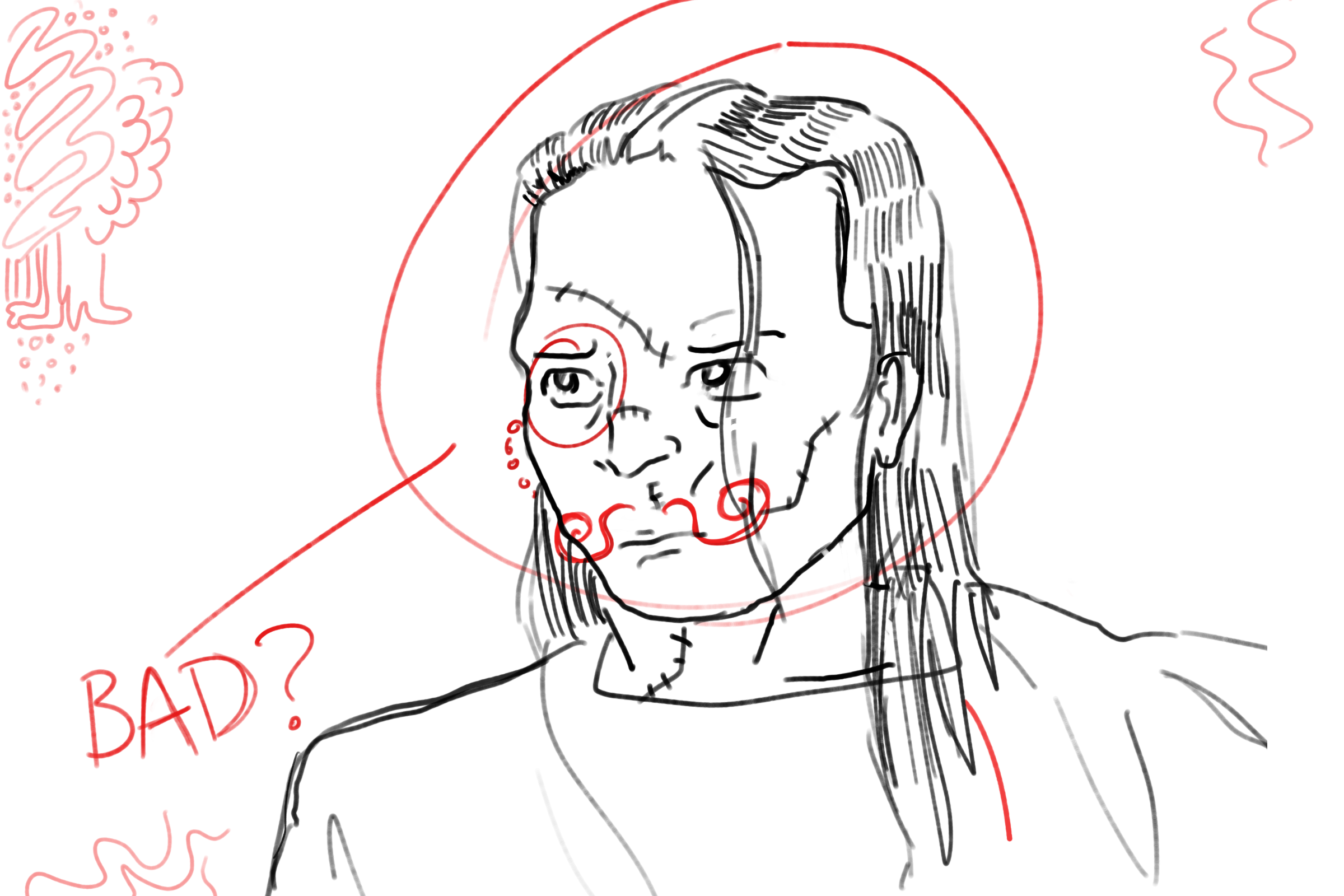
Hover over red text to see commentary.
Like many of you, I saw Guillermo del Toro’s “Frankenstein” last fall and was unimpressed. And, like many more of you, I was also assigned to read the original “Frankenstein” by Mary Shelley as a sophomore in high school. It was mediocre, and we’re all convincing ourselves otherwise. But that’s fine. Even though “Frankenstein” is an underwhelming work of fiction by an unpolished writer, I am in favor of mandating high schoolers to read it. I am also in favor of $120 million “Frankenstein” movies directed by award-winning directors who squander talents to churn out cash grab smut if that’s what they choose to do. The 2025 “Frankenstein” movie laid an egg at the box office, which I guess is one measure of a lack of success, but it also pushed no boundaries artistically, which may be the more important measure. The book has seeped everywhere into our pop culture, and its questions about hubris, prejudice, violence and ethics are still prescient today. With our accelerating production of very powerful artificial intelligence, one might even say that “Frankenstein” has remained topical for 200 years. Still, it flat out isn’t good as fiction. It’s clunky and full of plot holes. Every narrator sounds exactly the same, including an 8-foot-tall monster who is illiterate. The timing makes little sense. Character decisions make less sense. The nested story structure does not justify the length it adds to the book. Shelley is not as unforgiving an editor as she needs to have been, and as a result, readers have to slog through extended boring chunks of text that she seems to have personally liked in between the moments of actual story. When “Frankenstein” is criticized, many people’s reflex is to point to Shelley’s age when it was written (18), or the cultural impact it’s had since being published, but both of these responses are deflections. Neither of them convinces me that this book is any better as a literary work. Still, I argue that we need “Frankenstein” not because it’s that great of a work, but because its existence has benefited our culture in other ways beyond the intrinsic value of its art. For 200 years, “Frankenstein” has challenged us to consider the scary idea that our dreams can become dangerous, that our hubris will blind us and that humanity is developed instead of born. Since the turn of the 20th century, there have been many “Frankenstein” movies, ranging from horror to camp to del Toro’s tragic gothic romance. A human-made monster fundamentally terrifies us. In the realm of traditional horror stories and the folk traditions from which they arose, humanity’s enemies tend toward the supernatural, inexplicable and intrinsically evil. Frankenstein’s monster is none of the above. It’s easy for us to forget from our 21st-century perches how scary “Frankenstein” would be for a Europe undergoing the degradation of traditional morality and social structures that came with the Enlightenment and the Industrial Revolution. For a lot of people, science was usurping faith and, therefore, truth; the story of scientific excess and a human’s disastrous attempt at creating life at the heart of “Frankenstein” would have likely either reaffirmed their dreads or spooked them with a terrifying idea that hadn’t even crossed their minds yet. Del Toro’s “Frankenstein” is valuable, as it gives us insights into our modern pop culture’s approach to art and the adaptation of art into different media. The financial incentives of the film and TV industries encouraged recycling of well-known intellectual property, but that’s not even my point. Del Toro’s “Frankenstein” (and even Emerald Fennell’s 2026 adaptation of “Wuthering Heights”) both fall into this genre of “Netflix gothic revival,” which often draws on established literary classics or even old movies. Netflix gothic revival doesn’t necessarily have to be made by Netflix, but it does have to be beautifully shot, pretty expensive and a little schlocky. It’s usually very successful — even del Toro’s “Frankenstein,” a streaming movie, had a limited release but a strong financial performance. Maybe we need to go back and learn the best lesson of “Frankenstein” again. Mary Shelley’s book became a classic because it scared us by posing a question we’re naturally afraid to tackle. There is certainly still art that does the same thing today. I’m not sure if del Toro’s “Frankenstein” can be called one of them.Daily Arts Writer Elias Simon can be reached at elmsimon@umich.edu. I knew about Frankenstein and his Creature long before I read Shelley’s tale, and I’d be willing to wager you, reader, did, too. Even for those like my co-writer, who don’t love “Frankenstein” in its original or adapted forms, it’s impossible to ignore the impact it has had on our culture and the way we think about monstrosity in the 200-some years since its original publication. From stage productions to film adaptations to literary spin-offs, it is undeniably one of the most famous monster stories of all time. This is why, even for those of us who haven’t read the novel, almost everyone tends to have an idea of what “Frankenstein” means or is about — even if, ironically, they have been led to believe that Frankenstein is the monster instead of the creator. This is also why, even if you don’t like it, I am of the opinion we all still have to acknowledge that there is something — or really, quite a bit — to be admired in Shelley’s tale. “Frankenstein” is, at its core, a story of what it means to not belong. For those unfamiliar with Shelley’s version of the story, the novel follows Victor Frankenstein, a young and ambitious medical student who seeks to create life where there was none before. As he begins to turn away from his traditional medical textbooks and toward more archaic, fantastical forms of “medicine” to achieve this, Frankenstein also finds himself turning away from society at large, dropping out of university and secluding himself in an apartment-turned-laboratory. It is there that he spends the next two years attempting to not only reanimate but give new, unique life to a corpse — one that he has assembled from various other corpses, stolen from their graves in the night. Only, when he finally succeeds in creating new life, Frankenstein instantly regrets what he has done, and he abandons his creation (what some might even go so far as to call his “son”) on the operating table. Both of these characters — creator and creation — are othered by what takes place that night, never quite able to fit into the world around them ever again. It is this alienation that becomes the central conflict of the novel, each one believing the other is the cause of his ruin. It’s a deliciously thrilling and complex tale, woven through with lessons on mortality, morality and the true cost of scientific progress. And yet, it is also a quietly heartbreaking novel, deeply invested in exploring the Creature’s journey with otherness, isolation and abandonment — something which, for all its other shortcomings, del Toro’s adaptation explored better than any other adaptation I’ve seen before it. This is the reason why, though I read the book for the first time a few years ago for class, I still haven’t been able to stop thinking about it — or the story behind it — ever since. When one knows the author’s own story, it’s difficult to pretend not to see what her influences might have been in creating such a tale. Born Mary Wollstonecraft Godwin — named after her parents, well-known and acclaimed writers Mary Wollstonecraft and William Godwin — Shelley had a tumultuous and strained relationship with both of her own creators. In particular, the author’s relationship with her mother is often seen as not just an inspiration for, but also a direct driving force behind Shelley’s decision to tell the Creature’s story as she does. With Wollstonecraft dying only days after giving birth to her daughter, Shelley was haunted, practically all of her life, by the legacy of a woman she could never truly know. She was given her blood, her DNA, even her name, but never allowed to truly meet the woman responsible for giving her life. Understandably, the absence of this maternal figure had a profound impact on Shelley growing up, the effects of which can be seen throughout her novel, from the Creature’s lamentations at having no maternal figure of his own to the text’s eventual punishment of Frankenstein for attempting to create life in such an unnatural way. Many critics have even gone so far as to say the Creature is Shelley as she saw herself: ugly and motherless and unloved; completely alone in the world but for a creator who no longer wanted her; and a body that no longer felt quite her own. This is not to say that Shelley always felt this way. When she was a teenager, however, then-Mary Godwin met and began an affair with the 21-year-old Percy Bysshe Shelley, a famous poet and, unfortunately for them both, a married man. Disowned by her father for shaming their family, Mary was forced to elope with Percy and leave England for mainland Europe, where they eventually welcomed their first child into the world about a year later. Tragically, however, this child died just days after being born, a strange reverse-parallel of Shelley and her own mother. It was during this time, amid the throes of grief over the death of her child and abandonment by her parents, that Shelley’s “Frankenstein” came to be. In 1816, while visiting their friend Lord Byron in his house in Geneva, the Shelleys — along with Mary’s stepsister Claire and Byron’s on-site physician, writer John Polidori — entered a friendly writing competition to pass the time. The rules? Write the best ghost story to win. And thus were born Frankenstein and his Creature, the mad scientist and the motherless monster rejected by its own creator: a figure who, even today, many of us associate most closely with an innate and unnameable “otherness” — an otherness that, surely, a young Mary Shelley must have felt. Today, people read and love “Frankenstein” for a variety of reasons. Because we want to be scared; because we want to be moved; because our teacher tells us we have to, even if we have no interest in doing so. And yet, I have a sneaking suspicion that, for those of us who go willingly into Shelley’s tale, we are searching for something else entirely: We are looking for confirmation that, no matter how monstrous we may feel, we are never truly alone. Nobody wants to be an “other.” It isn’t a desirable position in life to find oneself in — being part of the group that always gets pushed to the margins, a monster hiding beneath human flesh. And yet, in some ways, all of us are others. Because the truth is, much as we may want to deny it, we all feel like monsters sometimes. This is why we find such comfort in monster stories: Even when we feel like Frankenstein’s Creature, “wretched, helpless, and alone,“ we can turn to stories like Shelley’s, and we don’t have to worry about being quite so abject anymore.Daily Arts Writer Camille Nagy can be reached at camnagy@umich.edu.