Is Gaylor harmless or harmful?
by Sophia Perrault and Campbell Johns
March 23, 2026
Hover over red text to see commentary.
In the early 2010s, Taylor Swift fans on Tumblr began shipping her with actress Dianna Agron. This was the start of “Gaylor” as we know it: the belief that Swift is non-heterosexual. Fans often point to the Queer subtext in Swift’s lyrics and music videos as proof of their claims. These easter eggs are an incredibly important part of the Swiftie fandom, giving credibility to Gaylor fans analyzing Swift’s art in this way. There’s also a long history of shipping Swift with other women in Hollywood, leading fans to analyze her “friendships” with them.
One of the most popular Gaylor ships is Kaylor: Swift and model Karlie Kloss. The two had a close friendship starting around 2012 until a messy falling out in 2018. In March 2014, Gaylorphiles deemed the two’s road trip to Big Sur strong “proof” of their romantic relationship because of the cabin the two rented: it only had one bed, was surrounded by lavender — a plant symbolic of LGBTQ+ empowerment — and wisteria, and the dates of the trip meant Swift missed her dad’s birthday and Kloss missed Paris Fashion Week for the first time since she started modeling.
Another popular Kaylor proof is kissgate. In December 2014 Kaylor shippers reported that Swift and Kloss attended The 1975 concert together. While there, other attendees filmed the pair. The leaked videos show an immense amount of physical touch between the two. Swift was apparently drunk, and grabbed Kloss’s face, boobs and waist multiple times throughout the night. In one video, it looks like the two kissed, further feeding into the rumors.
There are a slew of Swift songs rumored to be about Kloss, too. “Dress” is included, and the song reads quite sapphic. The first lyric is, “Our secret moments in a crowded room,” and a secret relationship is a prominent theme throughout. One lyric is repeated over and over again: “I don’t want you like a best friend,” which is a feeling Queer women can relate to given both the possibility of falling in love with a best friend and the societal impulse to believe women in Queer relationships are “just really good friends.” The lyric also fits directly with Kloss and Swift’s relationship. “Made your mark on me, a golden tattoo” is another supposed Kaylor lyric, since the two gave each other gold temporary tattoos for Drake’s 30th birthday party in 2016. During a Reputation secret session in 2017, fans mentioned that Swift explained the lyrics for “Dress” were written about a year ago, firmly placing the writing in 2016.
However, since 2018, Kloss and Swift haven’t been seen together publicly. Some in the Gaylor community believe the two are secretly still together, while others believe the relationship ended. Either way, Kaylor was fuel to the Gaylor fire.
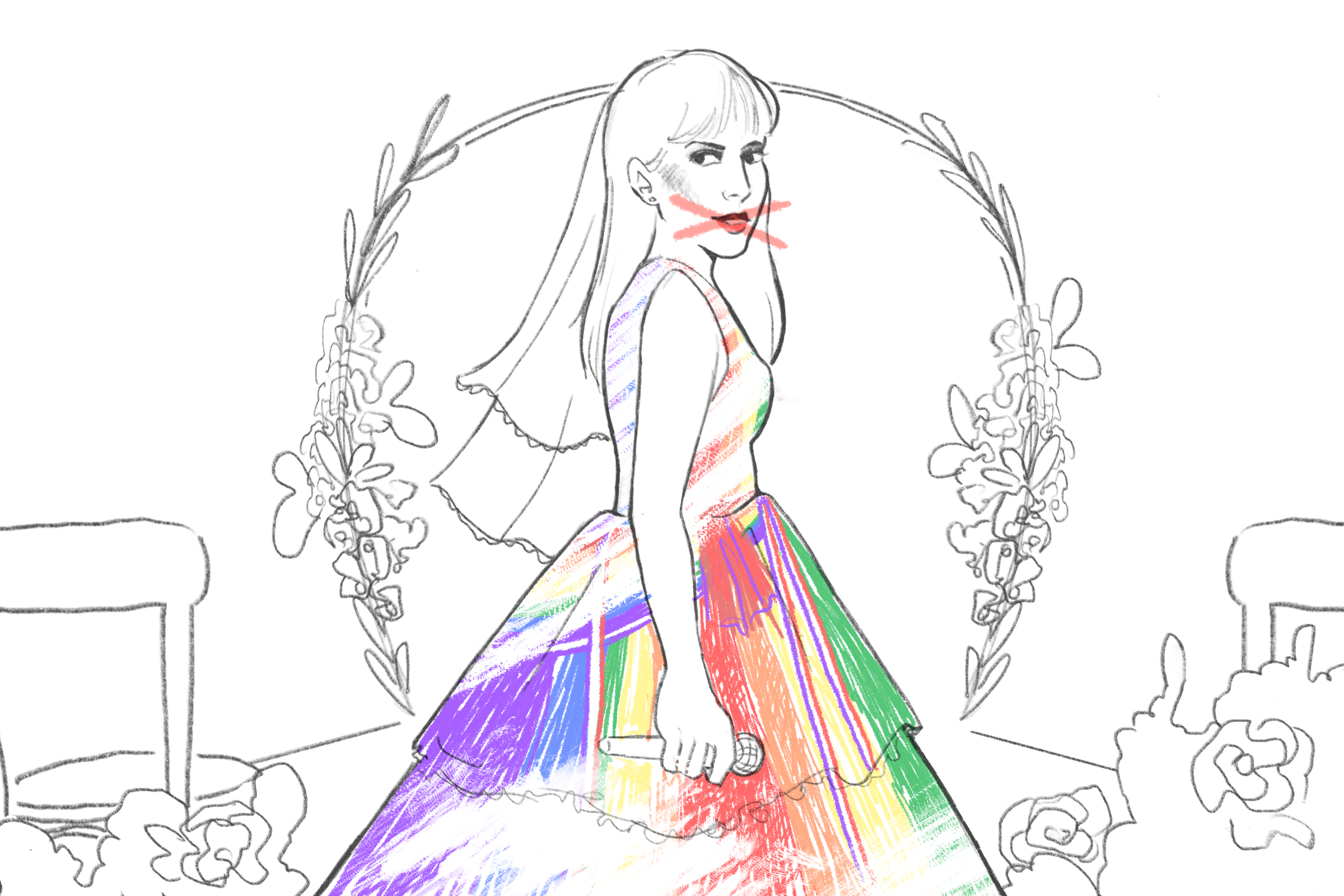
As a Queer Swiftie myself, I thought Gaylor had mostly died down after Kloss and Swift stopped being friends. While looking into Gaylor for this column, I realized just how wrong I was. Another strong Gaylor proof happened during the Lover era. There were rumors that designer Christian Siriano was making something for Swift. In 2019, Swift was supposed to perform at the Stonewall Inn and reportedly was going to come out as gay while there. She eventually backed out of the event, but Siriano posted a picture of a rainbow dress to his Twitter, along with seven rainbow emojis. Gaylors at the time speculated that the seven emojis represented Lover being the seventh album, and Siriano liking a comment that theorized the gown was for Swift only added to this theory. Siriano also reposted fan art of her in the dress, and later, a TikTok sipping tea in response to this theory. Fans took this as a confirmation of sorts and ran with it.
Gaylor proof doesn’t just stop in the Lover era either. Even now, with Swift engaged to Travis Kelce, Gaylors analyze albums and songs for more Queer-coded messages. Most recently, Gaylors looked at Swift’s latest album to add to their arsenal of evidence. Now bear with me for a moment, since I’m going to wade into some crazy territory: The overarching theme that Gaylors return to is that the title of the album — The Life of a Showgirl — implies that Swift has constructed an elaborate show for her 12th era. Many Gaylors believe they are literally listening to the life of a showgirl.
But there’s a catch — the Swift behind the screen is “Showgirl” Taylor, not “Poet” Taylor (the version of Swift from The Tortured Poets Department). Back during the Midnights era, Swift liked a post explaining that two versions of Swift in the “Anti-Hero” music video represent the then-upcoming Showgirl Taylor and Poet Taylor. The idea is that this latest album is a perfectly constructed performance, revealed by the title track. Gaylors point to this era as her ultimate show, one that means a new, more authentic and probably gay era is coming.
Of course, the Hetlors — those who believe that Swift is straight — disagree. Oftentimes, Hetlors send hate to Gaylors, saying they are delusional, living in fantasy and disrespectful to Swift. Gaylors have been doxxed by Hetlors, or been outed to their families.
If Gaylors are crossing boundaries, then I certainly understand calling them out. But that doesn’t mean outing fans or doxxing them. A poll by a fan in Australia found that most Gaylors are women, with only 15% being straight. Queer fans are allowed to create a community and relate to Swift’s music, and at its core, that’s what Gaylors are doing. Gaylors aren’t hurting anyone when they do Queer analyses of Swift’s songs or break down themes that feel particularly gay. Swift does love easter eggs, and she has used Queer symbols in the past. She’s never fully confirmed her sexuality, and although it’s often best not to assume the way a person identifies, Gaylors aren’t hurting anyone. At the end of the day, Hetlors need to let Gaylors be Gaylors.Opinion Columnist Sophia Perrault can be reached at sophiafp@umich.edu.
Do they, though?
Last January, the New York Times’ Opinion section published “Look What We Made Taylor Swift Do,” a pro-Gaylor guest essay primarily arguing that because Swift is the stereotypical all-American girl, her obvious attempts at coding her blatant Queer identityin her lyrics are not taken seriously. This essay brought the already popular Gaylor conversation even more into the mainstream, to the extent that an anonymous source close to Swift commented on the piece: “There seems to be no boundary some journalists won’t cross when writing about Taylor, regardless of how invasive, untrue, and inappropriate it is.”
But if it’s so untrue, why doesn’t Swift herself comment on the matter?
She has, multiple times. In an interview with Vogue during the Lover era, Swift said of her newfound outspokenness about Queer rights, “I didn’t realize until recently that I could advocate for a community that I’m not a part of.” In the prologue to 1989 (Taylor’s Version), she says of the infamous Karlie Kloss period that she thought, “If I only hung out with my female friends, people couldn’t sensationalize or sexualize that — right? I would learn later on that people could and people would.”
It’s pretty clear here that Swift does not consider herself to be a Queer woman — and if you take her words to be completely, unwaveringly true in metaphorical lyrics, it seems fair to have to believe what she says intentionally, too.
It doesn’t help her case, though, that so much of Swift’s so-called “activism” is wildly selective. If you’re committed to believing that she was 100% bound to come out around the Lover era, her shoddy advocacy matches that timeline and narrative perfectly. It’s just hard to swallow this notion as a reality when the rest of her activism has also been her floating an idea around, then backing into the shadows when something actually productive could've been done.
If she’s pretty explicitly stated her non-Queerness, why are Gaylors still so committed to this being true? And why, despite holes in their evidence, is that impulse still understandable?
At the peak of Kaylor, Queer girl pop stars were not as common as our current moment, with Chappell Roan’s explosion and “Lunch” by Billie Eilish on mainstream radio. It’s not a radical idea to imagine your favorite pop star as secretly Queer to fill this gap, especially with a fantasy that has this much fanfiction appeal. The world’s biggest, girliest pop star and a world-famous Victoria’s Secret Angel sneaking into each other’s hotel rooms at night? It’s inevitable for the young Queer girl craving any mainstream representation at all, let alone a story this narratively compelling, to fall for complete conviction for this fantasy.
And, as the New York Times piece points out, Swift is the all-American fantasy — a woman who barely, truly exists. Any woman that perfect is realistically flawed and cannot live up to the glitzy, smiling girl-next-door standard. If Swift, the model all-American girl, has secret late-night fantasies of women, can’t any burgeoning Queer girl, too?
Denying the Gaylor narrative feels like smothering girls who clung to this idea in the youth of their safety blanket, of their coming-of-age. It’s hard to blame them.Managing Arts Editor Campbell Johns can be reached at caajohns@umich.edu.