The problem with perfectionism in Animal Crossing
by Michelle Wu and John Rogan
March 23, 2026
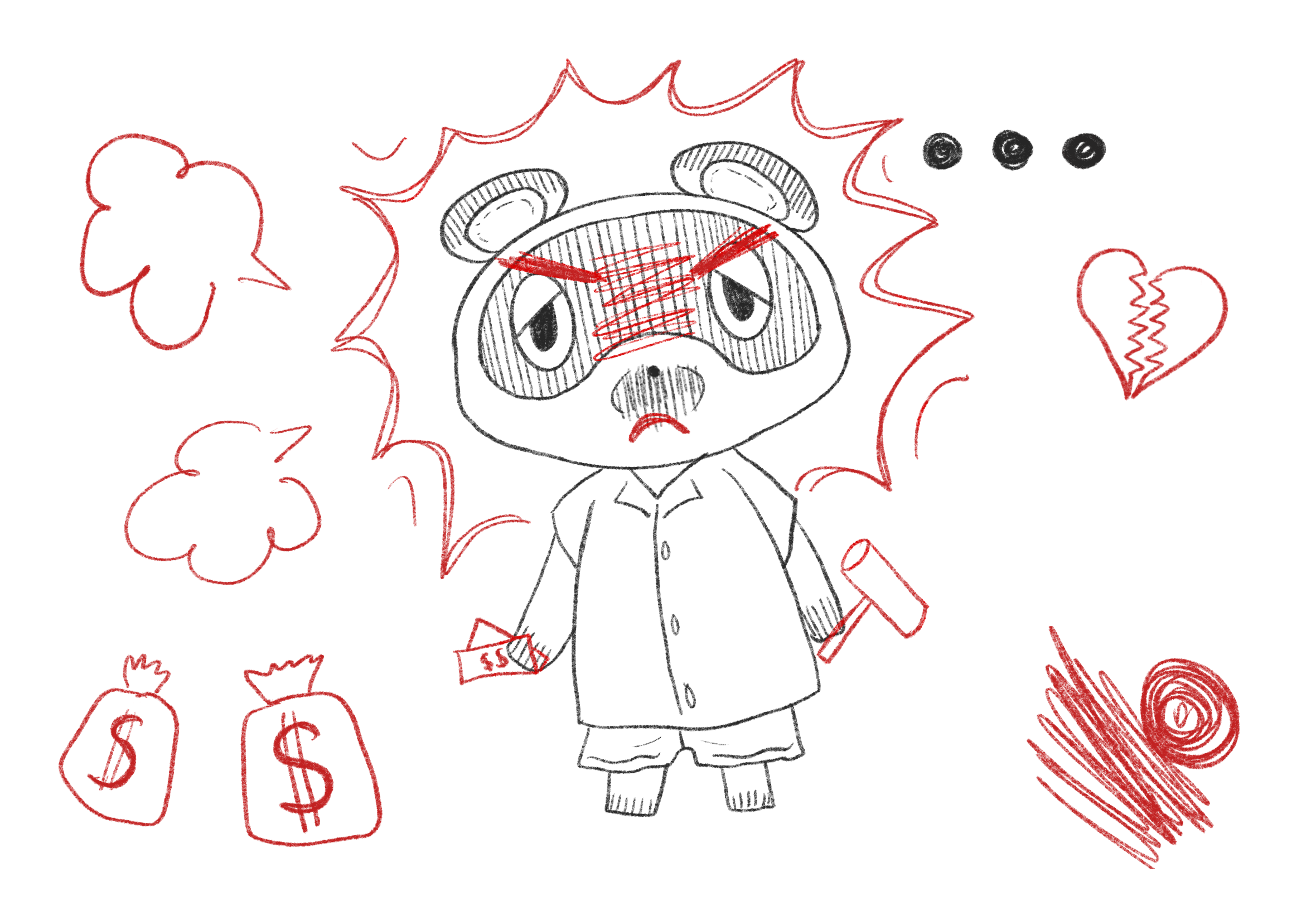
Hover over red text to see commentary.
I bought a Nintendo Switch and Animal Crossing: New Horizons a few years ago, inspired by the elaborate gardens, unique interior design and smart urban planning of ACNH content I saw online (yes … it’s the only game I have on my Switch). I was especially in awe of YouTuber Linh Troung's neatly organized and well-thought-out island tour. By the time I got ACNH, I optimistically believed I had found a way to live out my dream as an interior designer digitally. What I wasn’t aware of, however, was the amount of in-game money — or bells — it took to get through merely setting up the foundations to my island, let alone beautifying it. The Pinterest boards and YouTube playlists I made were no longer aspirational, only reminding me I wasn’t doing enough with my 300,000 bell loans that take hours, if not up to days or weeks, to pay back.
ACNH, released during the height of the COVID-19 pandemic, took the world by storm, becoming one of the best-selling video games in 2020. Looking back, it’s clear why this raccoon-run island franchise grew to such popularity during the pandemic: ACNH has an approachable gameplay that provides players with an open world and emulates everyday life. With its routine activities, lack of enemies and strict goals, the Switch game quickly became an avenue many people took to unwind. Couple that with the ability to customize clothing, furniture and island landscape to your heart’s desire, and you’ve got yourself a recipe where the world practically serves as your oyster. For imaginative dreamers and designers, ACNH seemed the perfect formulation for maximum comfort, providing the agency to control everything about your environment.
It’s no surprise, then, that ACNH brought the indie genre of cozy gaming into the limelight. Characterized by soft, colorful graphics, non-violence and safe environments, these types of video games aim to be relaxing escapes from a stressful world. Filled with deadlines, high expectations and never-ending to-do lists, our world is rife with reasons for burnout. Lacking the immediacy of completing missions or mastering playing a challenging character, players are encouraged to take their time performing the mundane pastimes of catching fish, planting flowers and selling fruit. But even as a space with no hard rules, the ACNH community has seemingly created an arbitrary definition of winning: cultivating a gorgeously curated five-star island.
Though I bought the game in hopes of relieving my daily stressors with something to pick up casually, ACNH and it’s online presence ended up discouraging me by always pointing out the money, or bells, I didn’t have. Maybe it was the impatience, the required perfectionism or my tendency to inevitably self-compare, but the sparks of joy I expected quickly became dread at the prospect of chopping down more trees so I could make furniture that I could then sell for more bells. What once started as a calming pastime meant to heal quickly transformed into a one-sided rivalry between the ACNH community and me. Whether it was who was the richest, who had the most creative themes for their island or who made the prettiest custom tiles, there was always some competition I was failing at.
Resources like guides and hacks to " become a bellionaire" are posted online to support struggling players. Similarly, Stardew Valley, a cozy farming simulator, has users posting entire spreadsheets about their inventory to maximize their gameplay. I admit that these videos are helpful to inexperienced gamers like myself, but in hindsight, they seem to erase the escapism aspect that led to the cozy game appeal in the first place. I now realize I need to be strategic about the in-game stock market and gardening seasons to maximize investments, and should have a well-organized system to plant the most efficient farm. These are not considered strategy games, but with the help of the internet, I’ve learned how to be “more productive” in slow-paced, cozy gaming.
There is no clear way to “win” a cozy game, but we seem to have constructed our own definition of it — a reminder of the perfectionism and productivity norms sewn in the fabric of society. But whether it’s the right way to secure victory in a game with loose rules or not, cozy gaming and its communities are undoubtedly topics worth commenting on. YouTuber bestdressed posted a more realistic island tour, critiquing the in-game capitalism and online threads have shared complaints about the ACNH community. So, perhaps it’s time to expand this conversation.Senior Arts Editor Michelle Wu can be reached at michewu@umich.edu.
Let’s.
Instead of enjoying the creation process in Animal Crossing: New Horizons, many players focus on the collectathon aspects of the game, such as grinding to catch every fish and bug and digging up every fossil. Players even go so far as to time travel, breaking the game’s mandated waiting mechanics to rush progress on their islands. Quite ominously, this need for speed parallels real-world trends of Generation Z’s obsession with the constant pressure of productivity.
With the release of New Horizons, the Animal Crossing community quickly made lists ranking the animal villagers you can have on your island, creating a divide between players who had “desirable” villagers and those who did not. Going even further, players made an online web shopping service called Nookazon, where users can buy and sell items and even trade villagers for bells. (Check out my Nookazon!) If you are lucky enough to start your island with Raymond, the most popular cat villager and highest trading villager on Nookazon, you can make a pretty penny almost immediately. This would allow you to progress ahead of other players, further corrupting the laid-back island feel the game intends to have.
This culture makes the villagers, your fellow island-dwellers and friends, another piece of capital you can use to curate your perfect island. Players who use these functions stop caring about what makes Animal Crossing special. Their goal is no longer to relax and slowly accrue items and meet villagers in a low-stress environment; instead, it’s to win a race to see who could get the most coveted villagers and the highest island rating the fastest.
It seems that there are increasingly fewer avenues for anyone to have a moment of true leisure. The dominating feeling is that if you aren’t working or grinding, you are falling behind. This sentiment bleeding into games like Animal Crossing is a grim indicator of players’ psyches. In fact, this hyperproductive play style has ended up giving some players burnout, which is depressing, considering this is a game where you spend time watering flowers and catching butterflies. Players with these dispositions end up ruining not only the spirit of the game, but the fun of the game itself. When digital vacation island management has become an onerous task, there is a serious problem. The capitalistic drive for productivity is robbing us of any real break from work. Everything has become something to excel at, with no room for mediocrity.
This ever-increasing focus on productivity is poisoning our collective minds. A trend among Gen Z is to maximize everything: Every moment and every aspect of life, even going so far as to append the term "maxxing" to words to represent this obsession.
The desire to eke every ounce of productivity out of the day has grown to a concerning level. In fact, in Silicon Valley, the Chinese-inspired 996 work culture is dominating tech firms. Programmers are working 9 a.m. to 9 p.m., 6 days a week, to try to escape a future economic class structure that artificial intelligence will supposedly bring. Much like the time traveling function being used to maximize growth in New Horizons, time becomes less of something we experience and more a means for production. We only need some connective tissue between AI agents and the game itself, and then it’d be theoretically possible to outsource our gaming experience to artificial intelligence entirely.
Perhaps instead of bellmaxxing and time traveling, we should stop to smell the mums and listen to the rain. Tom Nook doesn’t demand you pay your loans in any timely manner anyway.
John Rogan is an Opinion Analyst who writes about politics and technology. You may reach him at jerogan@umich.edu.